It starts the same way. The phone goes dark. The house is quiet. You should be asleep. And then the ceiling becomes the most interesting thing in the world.
One night, in Abuja, the author asked his wife a question. If every authority were removed — every restriction lifted, no fear, no panic, nothing holding you back — what question would you ask? He thought she'd say something about children, or travel, or the house. She thought for a long time in the dark and she said: "Why must we die?"
That question became a 106,000-word book — biology, philosophy, African cosmology, neuroscience, grief. This is not that book.
This book is for 3 a.m. It is seven nights, ten minutes each, a pen and a piece of paper. It is not philosophy. It is not theology. It is not therapy. It is what an older brother might tell you if he sat on your couch at 3 a.m. and said: I know. I know it is loud right now. Let me show you something that helps.
You do not need to answer the question at 3 a.m. You need to set it down gently so you can close your eyes and rest and wake up and live your life.
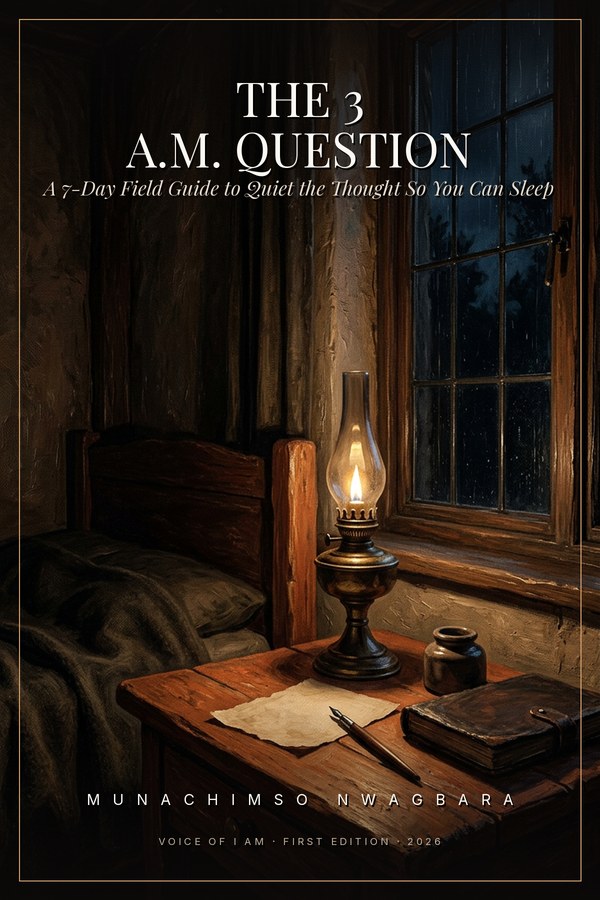
Each night's practice is built on the same discovery: the 3 a.m. question does not live in your mind. It lives in your body. You cannot out-think a body. At 3 a.m. your mind is an unreliable narrator — everything it produces is distorted, amplified, catastrophic. But the body is honest, and the body can be reached.
Over seven nights you learn to name the message, locate where it lives in the body, remember izu oke (wholeness, not perfection), pull out a photograph of the people you love, name the names you carry, write three sentences, and then — on the seventh night — learn when to stop.
One bad night at 3 a.m. does not only ruin the next day. It ruins the texture of weeks.
You lie there spiralling, then you sleep badly, then the next day you are short with the people you love.You begin to dread bedtime. The dread becomes its own anxiety, arriving before the question even shows up.You reach for your phone. The phone is not company; it is a deferral. The question waits for the screen to go dark.You spend the daylight hours avoiding anything that reminds you, and the avoidance shapes the shape of your life.Over years, the question becomes a ghost that walks your house. You do not have to live like that.A seven-night practice · ~10,000 words · EPUB + PDF
You do not need to answer it at 3 a.m.
Pay securely with Paystack · card, Apple Pay, bank transfer · instant download
No. Death anxiety does not have a cure. What this book gives you is a reliable way to set the question down at 3 a.m. so it does not ruin your sleep. In daylight the question returns on different terms, and the long book is there for that.
No. The practices draw on Igbo stories (Dog and Toad, izu oke) because those are the stories the author has inside him, but the exercises themselves (naming, body-scan, breathwork, photographs, three sentences) are available to anybody.
No. This is a standalone companion. Many readers will buy this first because they are tired tonight, and then later, when they are ready for the deeper investigation, they will buy the long book. The order does not matter.
Yes. The framework (name the message, locate it in the body, ground it in what is true, set it down) works for money anxiety, health anxiety, relationship anxiety, and any other 3 a.m. spiral. Death is the form the author knows best, which is why the practices are framed around it.
Use your judgment. The practices are gentle and do not argue with grief. But if you have lost someone in the last weeks, read the first two nights and see. If it does not feel right, set it aside. The refund is unconditional.
~10,000 words — about 50 pages. One short chapter per night. You can read the whole book in forty minutes, but the point is not to finish it; it is to do one practice per night for seven nights.
Yes — a printable body map and a printable three-sentences card, designed to be kept beside your bed.
Put this book beside your bed. The next time the ceiling becomes interesting, you will know what to do.
Get the book — $10 →