Voice of I AM · Inquiry Shelf
Munachimso Nwagbara · Longform

The Ancestor
You Are Becoming.

Every book, every retreat, every course on ancestry points backward. Heal your bloodline. Release the pattern. Break the cycle. Repair the lineage. Every one of them makes you a patient — damaged goods carrying a debt you did not sign for, working very hard to neutralise it.

That is half the picture. It is the half that looks over your shoulder.

Nobody writes the half that looks forward.

You are not only descended from ancestors. You are becoming one. And there is a documented Igbo practice for doing it deliberately — planting a thing that will outlive your ability to see it.

7movements
5appendices
~85ppEPUB + PDF
VOI-L17 cover art
Munachimso Nwagbara
₦15,000 one-time
Get the book →

EPUB + PDF · 30-day refund · instant download

✦ Pass it on:
The sentence the book builds to
A god is not sent. A god is started. — Chapter Three, Root

When you were born, they buried your cord in the ground and planted a tree over it. Nkwu alo. The tree of life. It secures land. It confirms blood. It binds you to Ala, the earth. You did not plant it. You did not choose the spot. Nobody consulted you.

Somebody planted you.

When a man dies, they destroy his chi shrine — the personal shrine to his own life force. They do not destroy his Agwu shrine. That one stays. His children keep it. Their children keep it. For generations.

There is a part of you that will not survive your own funeral, and a part that will. You are building both right now, with what you do with your life. The question is not will I be remembered. The question is which shrine are they keeping.

How the book moves

Seven chapters. One tree.

The book is built the way a tree is built. Read it in order. It is short — about eighty minutes — and written that way on purpose.

SeedYou already have a tree. Nkwu alo. The difference between chi (destroyed at death) and Agwu (kept by your children). The two rites — Ime Agwu and Iru Agwu — and why the order matters.
GroundPersonal land, not rented. The bare patch of earth with nothing on it and everything under it. Covenants. Why a landlord's quit notice would dismantle your shrine, and what to do while you do not yet own land.
RootTwo sticks. Not seeds. Cuttings from your mother's tree and your father's tree. A stick is an inheritance, not a beginning. The rite described plainly — two delegations, two holes, two sticks, one week.
TrunkThe dibia who farms. The man does the rite and then goes back to farming. Character, not ceremony, keeps the tree alive. A man who cannot hold a job for two years is not ready to hold a tree for forty.
BranchBound to water them. Your children did not choose your tree. Your job is not to force them to serve it. It is to water it well enough that they can choose it.
FruitHow a tree becomes a god. A man plants a stick alone in his compound. His children tend it. His children's children tend it. Four generations later a whole community sacrifices at that tree. A god is started by a person nobody was watching.
ShadeThe part you will never sit in. You plant trees you will not live to see tall. "A good man leaveth an inheritance to his children's children" is not wisdom about money. It is a description of what a human being is for.
For the person who is far from home

Your ancestors already solved migration.
They did not tell you to come back before you could build.

This is not a ceremony manual. The book does not teach you to perform a rite. Rites belong to lineage and land, and you enter them through your own people, in person, with somebody who knows what they are doing. If you finish this book able to perform anything, the author has failed. What you get is the shape of the thing, why it exists, what it asks of you, and how to start asking the right people the right questions.
Get the book

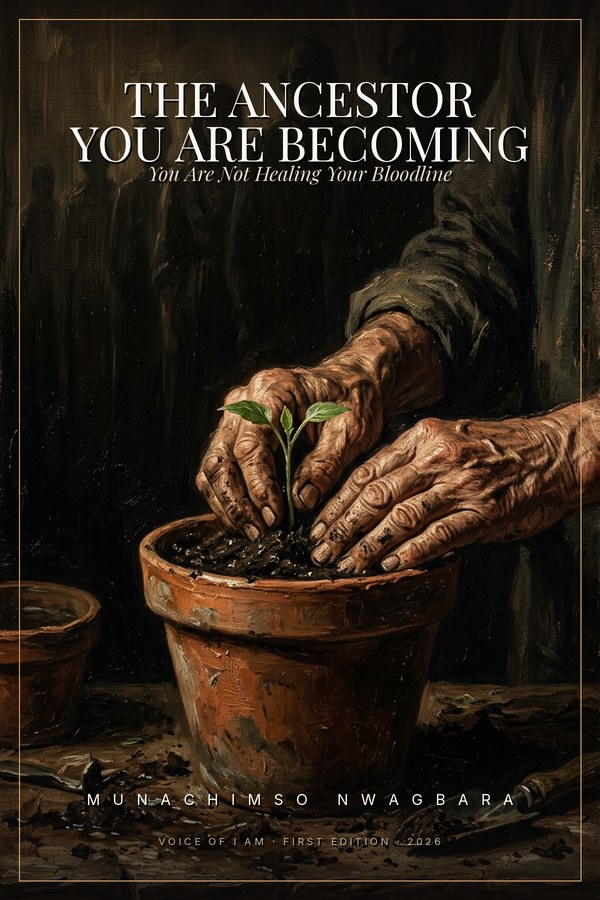
The Ancestor You Are Becoming

Seven movements. Seven weeks. One thing planted.

₦ 5,500 one-time · EPUB + PDF · ~85 pages
  • The complete book — seven movements, one coda, five appendices, EPUB + PDF.
  • Appendix A: The Founding Map — the sequence, on one page.
  • Appendix B: Seven Weeks — one physical act a week for seven weeks. Do not start it until you have read the book.
  • Appendix C: Glossary — Igbo terms marked [T] author's teaching, [O] oral tradition, [V] verifiable in published sources.
  • Appendix D: When This Is Not For You — the plain disqualifiers.
  • Appendix E: Notes and Sources — published scholarship (Aguwa on Agwu, Meyer on Ewe missions, Erikson on generativity, McAdams, the Harvard Study) and the author's own recorded words, clearly marked.
  • Lifetime updates. Every new edition, free.
  • 30-day refund. Read it. If it does not meet you honestly, message us on WhatsApp. Full refund.

Pay securely with Paystack · card, transfer, USSD · instant download

About the author

Written from the preparation,
not from the far side.

M

Munachimso E. Nwagbara writes from Mgbowo, Enugu State. He is thirty-three years old.

He has done Ime Agwu — both sides, his father's and his mother's. He has not done Iru Agwu. He is getting ready, and this book is part of that preparation. He is not writing from the far side of anything.

"A man who has finished would be tempted to sell you the finish. I have not finished, so all I can do is show you the road, tell you what it costs, and walk it with you."

Questions

The ones you are asking.

Do I need to be Igbo or African to read this?

The practice described is specific to Igbo life and land. The argument — that generativity rather than healing is the adult task, and that you plant things you will not sit under — does not belong to one people. Read it for whatever in it is yours.

Will this tell me how to perform Iru Agwu?

No. That is the point. It tells you what it is, what conditions it requires (your own land, both sides, one week, two delegations), and why you cannot fake it on rented ground. It tells you where to start. It does not, and cannot, initiate you.

I do not own land. Is this book for me?

Yes. Stage one is available to you now. Most of you reading this do not own land, and the author knows that. The chapter on ground is written explicitly for people who rent in Lagos, London, Houston, Toronto, Johannesburg or Dubai.

Is this a Christian book? A traditional book?

It holds Proverbs 13:22 alongside Igbo rite and Erik Erikson's developmental research. It does not reconcile them into a system. It puts them next to each other and lets each do what it does.

How long is it?

Roughly 18,000 words — about 85 typeset pages. The author wrote it short on purpose.

Tonight

Plant what you carry.
Water what you plant.

You are not a house being renovated. You are a tree.

Get the book — ₦15,000 →
The Ancestor You Are Becoming — ₦15,000
Instant EPUB + PDF · 30-day refund