Munachimso E. Nwagbara · Before You Enter the Forest

Before You Leave.

He did not write this as a Christian trying to win you back. He did not write it as a dibia trying to recruit you. He did not write it as an atheist trying to convince you there is no Chukwu. He wrote it as someone who has lived inside the questions.

He was born into a Christian home. He inherited prayers, hymns, scriptures, and a sincere faith that carried his family through hard years. He also inherited names, language, stories, and a village that existed before those hymns arrived. For a long time he did not know how to hold both without betraying one.

This book is not Who Is God? That book is the longer investigation. This one comes before that. It is for the moment when inherited answers stop working — when you are afraid to say aloud that you are questioning; when you love your mother but can no longer pray exactly as she taught you; when you leave one authority and discover that another person is already waiting to sell you certainty.

If Who Is God? is the map of the forest, this is the compass you use before entering it.

Do not use it to insult the people who gave you a beginning. Use it to become responsible for what you do with that beginning.
3movements
~12kwords · ~60pp
13prompts
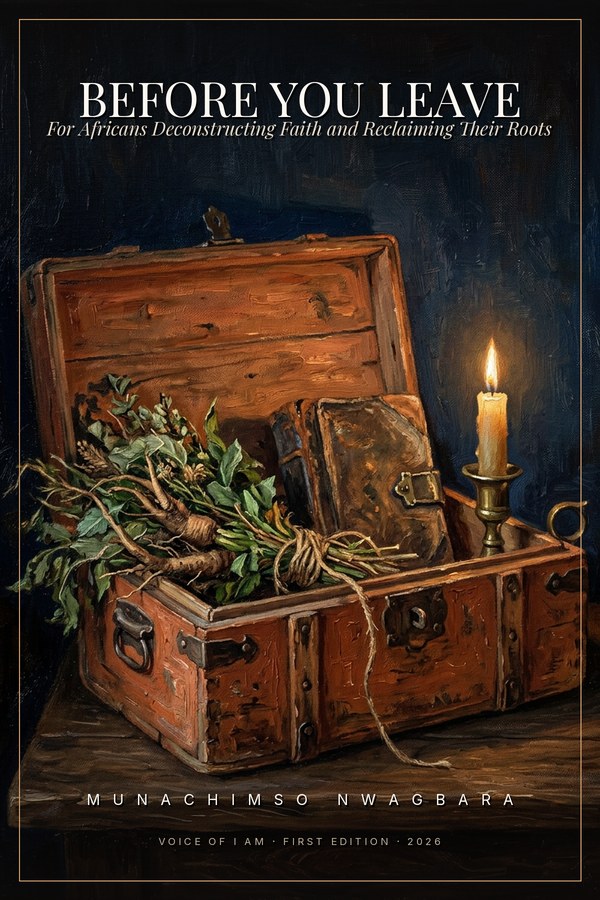
VOI-L15 cover art
Munachimso E. Nwagbara
₦11,000 one-time
Get the book →

EPUB + PDF · printable journal · lifetime updates

✦ Pass it on:
You were not born with a religion. You were born with a body, a family, a place and a language. Before you could examine a worldview, people around you were already naming the world. Chukwu. God. Jesus. Ancestors. Heaven. Hell. Sin. Destiny. Those names arrived before you had the tools to ask who chose them, what they meant, or whether the claims attached to them were true.

Questioning an inheritance is not automatically rebellion. It is one way to discover whether what you were given has become genuinely yours.— Chapter 1, You Were Not Born With a Religion
Three movements, thirteen prompts

Inherit. Question. Investigate.

The book is short by design. Each chapter ends with a single writing prompt — a line to complete in a notebook. You are not asked to answer quickly, publicly, or in a way that makes you look wise. A private answer is still an answer.

I · InheritSix chapters, six promptsYou were not born with a religion. Your mother was not the enemy. Christianity did not begin with you. Before the English "God" there was Chukwu. Your ancestors were not empty. Going back does not mean going backward.
II · QuestionThree chapters, three promptsWhen the answers stop working. The day you start asking. You can leave and still be lost (pastor → dibia is relocation, not freedom, if the pattern of dependence is identical).
III · InvestigateFour chapters, four promptsKnow what you are actually looking for. How to investigate without being scammed — eight questions. You are allowed not to know. The Evidence-Status Test (I Know / I Believe / I Was Told).
BonusThe Bank Alert That Tests FaithA short section on how transactional spirituality exploits the vulnerable moment of leaving, and how to protect yourself while searching.
Freedom is not changing masters. Freedom is learning how to investigate, refuse, revise, and choose.

You can pour libation and still use a microscope. You can respect ancestors and still send your daughter to university. You can speak Igbo and still write code. These combinations do not automatically make a complete worldview, but they show that identity is not a single switch.— Chapters 6 and 9
If any of these are you

This compass was written for you.

You are standing at the edge of the forest.

  • You grew up Christian and the answers stopped working some time ago, but you cannot say so out loud.
  • You have started exploring Odinala or tradition and you are scared of repeating the same dependent pattern with a dibia that you had with a pastor.
  • You love your mother and you cannot pray the way she taught you anymore, and you do not know how to hold both truths.
  • You left the church and got recruited into something else that sells certainty in a different accent, and you can feel the same cage forming.
  • You are being told that "not knowing" is a sin, or weakness, or evidence that someone else must take over your mind.
  • You want to investigate before you commit to anything else, but every voice around you wants you to pick a side today.
  • You are an atheist, a seeker, a returnee, a doubter, or someone who is simply tired of being told what to think by people who do not know you.
This is not a deconstruction book designed to turn you against your family, your church, or your tradition.It also does not tell you what to believe at the end of it. It gives you a method — a set of postures, distinctions, and writing prompts — so that whatever you end up believing is actually yours. You may return to Christianity. You may end up in a traditional practice. You may land in a syncretic life the categories do not yet have a name for. You may remain uncertain. What you will not be, if you do the work, is easily recruited.
Get it now

Before You Leave

3 movements · 13 prompts · ~12,000 words · EPUB + PDF

₦11,000 one-time

You inherited a starting point. You did not inherit the obligation to stop thinking.

  • The complete compass. 13 chapters, author's note, epilogue, printable journal pages with all thirteen prompts. EPUB + PDF. ~60 pages.
  • Printable prompt journal — space to write each of the thirteen answers, designed to be kept private.
  • The Evidence-Status Test (I Know / I Believe / I Was Told) — the discipline that protects you from your next authority.
  • The eight investigation questions for evaluating pastors, dibias, babalawos, books, elders, online teachers, and AI systems.
  • Cross-tradition — treats Christianity, Islam, Odinala, and secular worldviews with the same standard; does not favour one.
  • Lifetime updates. Every new prompt or revised chapter free.
  • 30-day refund. If you work through the thirteen prompts and have not gained clarity about where you stand, email us. Full refund.

Pay securely with Paystack · card, transfer, USSD · instant download

About the author

He wrote this from inside the question.

M

Munachimso E. Nwagbara is from Mgbowo, Enugu. He was born into a Christian home and has spent much of his adult life in the terrain this book describes — between inherited Christianity and the inherited traditions that existed before it, between what his mother taught him and what his own eyes have seen.

He will tell you plainly that he is not writing from a settled position outside the question. He is writing from inside it, as a fellow traveller, with the same vulnerabilities to recruitment, to romance, to easy certainty, that every seeker has. The book is the compass he wished he had been handed when the answers first stopped working.

Read this before reading Who Is God? (L09) or any of the longer books. It is short on purpose — because at the moment the answers stop working, you do not need a 100,000-word treatise. You need a compass.

Questions

The ones before you buy.

Does this book tell me to leave Christianity / return to tradition?

No. It tells you how to investigate so that whatever you end up doing is chosen rather than defaulted into or reacted into. The author has seen people return with clearer eyes and people leave with clearer eyes, and considers both outcomes preferable to unexamined acceptance or unexamined reaction.

Will this hurt my relationship with my parents?

Chapter 2 ("Your Mother Was Not the Enemy") is devoted specifically to this question. The book teaches you to separate love from agreement, to honour the people who gave you a beginning without being trapped by every line on their map. It does not guarantee every relationship will survive your honesty — some relationships are built on control, not love — but it gives you tools for the ones that can.

I've already left the church. Is this book still for me?

Especially. Chapter 9 ("You Can Leave and Still Be Lost") is written for people who left one structure only to walk into another one — a different priest, a different payment, a different certainty, the same cage. If you have relocated without investigating, this book will show you.

Do I need to read this before Who Is God?

Recommended but not required. This compass is for the moment before you enter the forest. The long book is the forest itself. If you are currently in crisis, in doubt, in the vulnerable moment between one authority and the next, start here.

Aren't journal prompts a bit self-help?

They are. They are also one of the oldest technologies we have for thinking something through in private rather than in the presence of someone who wants to recruit you. The prompts are short, concrete, and designed to produce answers you can look back at in a year.

How long is it really?

~12,000 words — about 60 pages. You can read it in an afternoon. The prompts will take you longer, which is the point.

Start wherever you are

Do not believe me simply because I wrote it.
Investigate me too.

Read slowly. Write. Return to the questions after emotion has settled. You inherited a starting point. You did not inherit the obligation to stop thinking.

Get the book — ₦11,000 →
Before You Leave — ₦11,000
EPUB + PDF · printable journal