An older relative stood over him in the dream, looking at him with pity. Not hostility. Pity — the softness of a man delivering news he thinks you have failed to notice about yourself. He said: look at you. Life has done to you what it did to me. You have become me.
He refused it. Not with an argument. He did not say "you are wrong" or "my life has been different." In the dream, with all of his adult vocabulary asleep, he said one thing: bring a mirror. He made the older man stand beside him in front of the long glass. He looked. And the mirror showed him this: the older man's skin was dark, and his own — his own was somehow lighter. Clearly, visibly lighter, by a margin nobody could dispute.
He took this as proof. Total, immediate, unanswerable proof. He woke up pleased. He carried that pleasure for years. Then, slowly, he realised what the mirror had done.
It did not show what daylight shows. Awake, in ordinary light, that difference is not there. The mirror took a side. It produced a distinction sharp enough to win an argument, and it produced it at exactly the moment he needed one. He had asked a question and the answer came back in his favour, immediately, with a clarity reality does not usually supply. A mirror that agrees with you is not a mirror. It is a room with your opinion painted on the wall.
That is the starting point of this book. You did not choose the first time. Nobody does. Your first language arrived before consent. Your first god arrived with your first meals. You have since acquired the ability to assess. Therefore everything you currently believe is held one of two ways: by decision, or by default. From the inside they feel identical. Conviction does not come with a receipt. Twenty-eight laws for finding the seam.
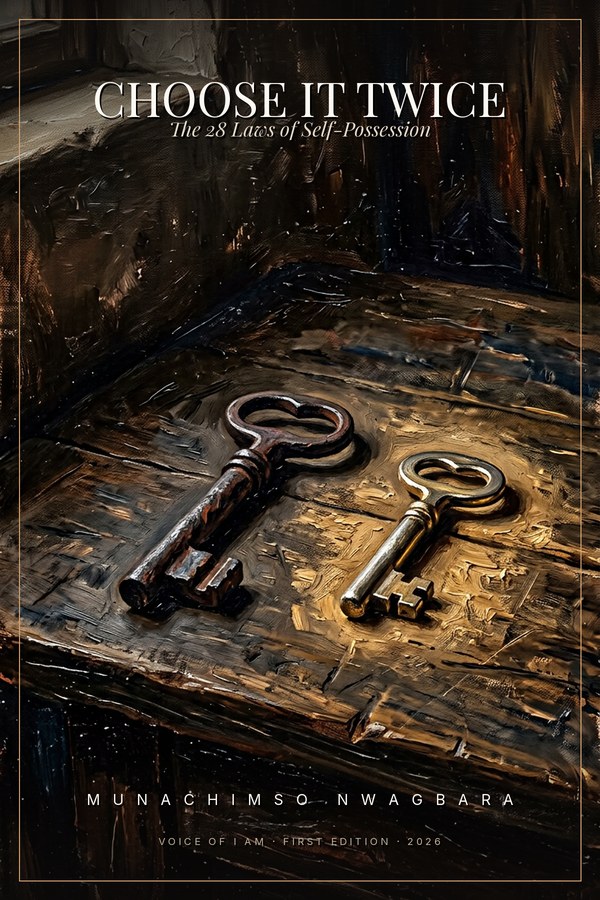
You were handed a set of answers before you could assess them. You have since acquired the ability to assess. The uncomfortable arithmetic is that most people have never audited which of their beliefs fall into which pile — not because they are lazy or stupid, but because a belief held by default and a belief held by decision feel exactly the same from the inside. That is the whole difficulty.
A life held by default does not announce itself as such. It announces itself in specific, concrete outcomes:
You spend your fifth decade living a script written for you by a seventeen-year-old version of yourself who was, at the time, trying to please everyone. You stay in a church or a political tribe or a marriage long after you stopped believing in it, because the cost of leaving is visible and the cost of staying is invisible. You pass things on to your children that you do not actually want them to carry — patterns of anger, patterns of fear, patterns of deferral — because you never stopped to examine them. You argue ferociously for positions you would never have arrived at on your own, because identity has wrapped itself around the default answer and the whole thing feels like "you." You wake up at forty with a life that looks successful from the outside and a quiet internal conviction that you are a stranger in it.Appendix A grades all evidence. The author flags his own readings. This is not a book urging you to reject everything. It is a book teaching you to look, then decide.
There is no template life at the end of this. The author will not tell you what to believe about God or your family or your career or your marriage. That is the point. A belief you arrive at by decision will look different from a belief you arrived at by default even when the content is identical — because one belongs to you and the other never did.
28 laws · 3 interludes · ~101,000 words · EPUB + PDF
Conviction does not come with a receipt.
Pay securely with Paystack · card, transfer, USSD · instant download
No. Some readers leave. Some stay and rebuild. Some find what they had was already theirs. The book is honest about the cost of leaving and the cost of staying. It does not prescribe either. It prescribes the inspection.
Most deconstruction books leave you in the rubble. This one begins in rubble and ends in rooting. The final law is "Leave a root, not a leash." The point is not to tear down. The point is to choose.
No. It applies to political conviction, to career scripts, to ideas about masculinity and marriage and parenting and money that you absorbed from the rooms you grew up in. The altar is not always a church altar. The grammar is not always a religious grammar.
There is a specific kind of certainty you will lose — the borrowed kind. The book argues that what replaces it is sturdier, not weaker, because it is yours. There is also a chapter titled "Change With It, or Be Buried With It" — he is not arguing for paralysis or permanent doubt.
Formally no. Practically, yes. If you cannot yet watch your own thoughts, and if you cannot spot your own tendency to be charmed into lending feathers, the mirror test will not work. You will use the book to prosecute other people's beliefs instead of auditing your own.
~101,000 words — about 520 pages. It is the longest Longform. Two chapters a week. Pause after each interlude. Do not rush.
Then the book did its job. Part IV walks you through the choosing that comes after — rooting deep, walking out and paying the price, standing where no one can evict you, leaving a root not a leash. The end of the book is not doubt. It is chosen ground.
No. The book contains an account of a man who did it at sixty. The only cost of waiting is that more years get spent living a life you did not author.
You have since acquired the ability. The question is whether you will use it.
Get the book — ₦15,000 →