Munachimso E. Nwagbara · Bridge essay

Death Was Never
The Problem.

Bryan Johnson wakes at 5 a.m. without an alarm. He swallows sixty supplements arranged by a medical team the night before. He weighs himself, measures his body fat, checks his blood pressure and heart rate variability and oxygen saturation. He exercises for exactly one hour — the routine changed daily by what his data says his body needs. He eats breakfast, the same breakfast, blended into a consistency chosen for nutrient absorption. It does not taste good. It is not supposed to.

This has been every day for five years. It costs two million dollars a year. A team of thirty doctors. Full-body MRIs on rotation. Continuous glucose monitoring. Millions of data points. The goal is not a good life. The goal is not-dying. Those turn out to be different projects.

In February 2026 he launched "Immortals." One million dollars a year. Three spots. Fifteen hundred people applied. In July he announced a diagnosis of autoimmune gastritis — chronic, incurable. The internet responded with schadenfreude. He posted: "The world wants me to die." He was not entirely wrong.

Meanwhile in a compound in southeastern Nigeria, a grandmother who has never taken a supplement and never had a biomarker measured sits under a tree preparing for a death that will cost her family less than one day of Bryan Johnson's supplement budget. She is not trying to defeat death. She is trying to die well. And she has been solving that problem for a thousand years.

This book is an argument that the grandmother is right. Not because her science is better. She is right because she is asking a better question. The longevity industry asks: can we defeat death? The grandmother asks: can we die well? The answer to the second question is yes. The answer to the first question does not matter if you get the second one right.
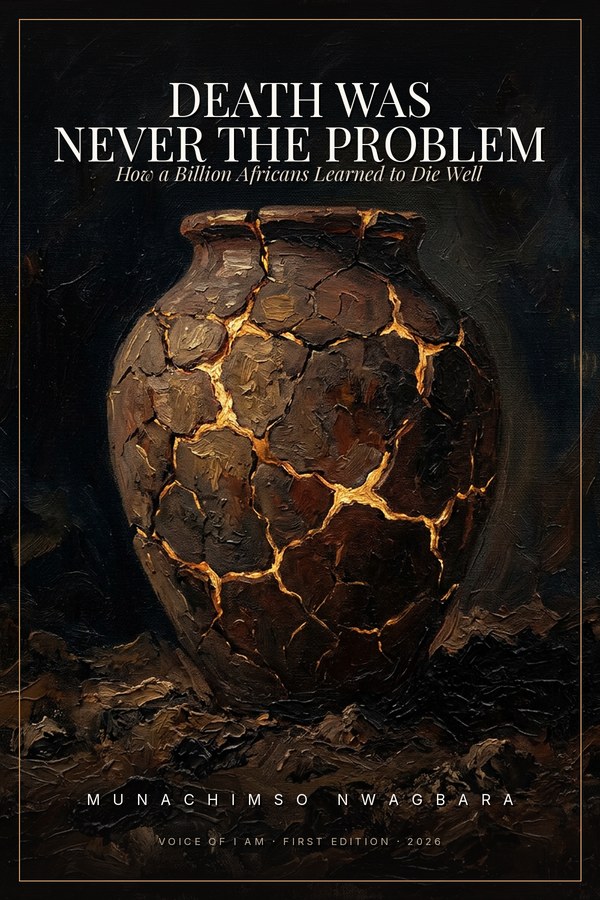
18chapters
4parts
~48kwords · ~240pp
VOI-L13 cover art
Munachimso E. Nwagbara
₦11,000 one-time
Get the book →

EPUB + PDF · lifetime updates · 30-day refund

✦ Pass it on:
Johnson is the toad. I do not mean it as an insult. He is the most persistent, most deliberate, most unfaltering messenger in the history of the human conversation about death. He does not stop. He does not eat, except exactly what his protocol specifies. He does not rest, except for exactly the right number of hours in a temperature-controlled pod. He just keeps moving, one deliberate optimisation after another, toward the feet of the culture that grants decrees.

And the dog is all of us. Carrying the hopeful message. But the dog keeps getting distracted. The dog passes a Netflix series, a mortgage, a wedding, a football match, a vacation, a promotion — and the errand slips from its mind the way water slips through open fingers.— Prologue, The Dog, the Toad, and the Billionaire
The argument in a single sentence

Death is not the problem.
Dying badly is the problem.

The sixty-billion-dollar longevity industry is not solving death. It is industrialising denial. The American hospital is a place where nobody dies — where death is treated as a failure of management, a bug in the system, something that might have been prevented if one more test had been run, one more intervention attempted, one more specialist consulted. The result is not longer life. It is longer dying, more expensive dying, dying in a room full of machines with nobody who knows your name.

Against all that, the Igbo framework offers something specific and practicable: a taxonomy of good deaths and bad deaths, a second funeral that does the work of transition, an understanding of ancestors as relationship rather than magic, and izu oke — wholeness, not perfection — as the thing you want to arrive at before you go. It does not defeat death. It organises life around death so skillfully that when death arrives, it arrives into a context that can hold it.

The body is not an engineering problem. It is a living thing — messy, unpredictable, occasionally perverse — and it does not always respond to the interventions that reason suggests it should respond to. This is not an argument against trying. It is an argument against the claim that aging is solvable, that death is an engineering challenge, that with enough money and data the human lifespan can be extended indefinitely.— Chapter 1, Two-Million-Dollar Morning
If any of these are you

This book was written for you.

You have sensed that something is wrong with how we die now.

  • You have sat beside a dying relative in a hospital where every intervention was being deployed and nobody was willing to say the word "dying."
  • You have read about Bryan Johnson or his peers and felt a mixture of fascination and revulsion you could not name.
  • You are Igbo, in the diaspora or at home, and you know there is a framework for good death but you have never seen it brought into serious conversation with modern biology or Silicon Valley.
  • You are not Igbo, but you have watched Western death-denial produce worse and worse deaths and you want an alternative that is not religion and not stoicism.
  • You have read Why Must We Die? and you want the bridge between the Igbo framework in that book and the concrete cultural collision happening right now.
  • You are thinking about end-of-life planning for your parents or for yourself, and you do not want to choose between hospital hubris and outright denial.
  • You are tired of the way "death positivity" in Western circles often means little more than stylish acceptance language over the same terror.

What dying badly costs — right now.

The denial industry does not only fail to deliver immortality. It produces specific concrete harms:

Families spend their last savings on interventions that extend dying by days or weeks, not living by years.Old people die in ICUs without a single hand being held, because the system treats every death as a failure.Children are not in the room. Last words are never spoken. The ethical will is never given.Grief is pathologised, medicalised, outsourced to professionals, because the culture has no framework for it.Wealthy people spend hundreds of millions on longevity protocols whose endpoint is not a good life but a longer one, stripped of spontaneity, cake, the second glass of wine, the afternoon nap.
Eighteen chapters in four parts

The collision between Silicon Valley and a grandmother in Mgbowo.

Part I · The Dog Ate the MessageHow the West Got Death WrongBryan Johnson's morning. The hospital where nobody dies (personal: his father's death). The denial machine. The sixty-billion-dollar lie.
Part II · The Grandmother Who KnewThe FrameworkỌnwụ ọma (good death). Ọnwụ ojọọ (bad death). The second funeral. Ancestors are not a hypothesis. Izu oke: wholeness, not perfection.
Part III · The CollisionWhat Happens When the Two Messages MeetDog and Toad in Silicon Valley. Ogbanje and the immortality trap. Six lines in the sand. The Compound. What death cannot touch.
Part IV · The PracticeWhat You Can Do Before Anyone DiesTen questions to ask before anyone dies. The modern ethical will. The 3 a.m. practice. The dog is still walking. Epilogue.
This book is not anti-science and it is not anti-medicine.The author is not arguing against longevity research, or against hospitals, or against trying to live longer and healthier lives. He is arguing against the specific claim that death is an engineering problem to be solved, and against the specific culture of denial that makes dying in the modern West so expensive, so lonely, and so badly done. Good medicine is part of a good death. The grandmother would approve of antibiotics and clean water and pain control. She would not approve of two-million-dollar protocols whose endpoint is not-dying rather than living.
Get it now

Death Was Never The Problem

18 chapters · 4 parts · ~48,000 words · EPUB + PDF

₦11,000 one-time

The grandmother has been solving the actual problem for a thousand years.

  • The complete essay. 18 chapters, prologue, epilogue, source notes. EPUB + PDF. ~240 pages.
  • Bryan Johnson's story told carefully — the protocol, the Immortals programme, the gastritis diagnosis, the clone claim, the Tithonus comparison — without cheap mockery.
  • A personal chapter on his father's death in hospital — the oxygen machine, the monitor, the phone call that came while he was answering another phone call.
  • The five-chapter Igbo framework (good death, bad death, second funeral, ancestors, izu oke) presented as a living alternative, not as ethnography.
  • Six lines in the sand — concrete things to say no to in a modern hospital, and concrete things to insist on.
  • Lifetime updates. Every new edition free.
  • 30-day refund. Read the prologue and Part I. If you do not look at a hospital, or a supplement bottle, or your own parents differently, email us. Full refund.

Pay securely with Paystack · card, transfer, USSD · instant download

About the author

He sat beside his father while he died.

M

Munachimso E. Nwagbara writes from Mgbowo, Enugu. He has written a long book asking Why Must We Die? and two companion guides — The 3 A.M. Question and Good Death, Bad Death. This book is the bridge essay he wanted to exist and could not find: a book that takes Bryan Johnson seriously without taking him at his own valuation, that takes Igbo eschatology seriously without romanticising it, and that treats the Western death industry with the scepticism it has earned.

He writes from personal experience of his father's death in a Nigerian hospital, from years of sitting with elders in Mgbowo, and from reading deeply in the longevity literature, bioethics, and African cosmology. He is not a bioethicist. He is a man who watched one tradition die badly and another handle it well.

Questions

The ones before you buy.

Are you saying Bryan Johnson is a villain?

No. The book takes his project seriously as a structural and cultural phenomenon, but does not mock him. The diagnosis chapter treats him as a man doing what the culture has told him to do — take control, measure everything, refuse to accept limits — and discovering, expensively, that the body has other plans.

Do I need to read Why Must We Die? first?

No. This book stands on its own. It is shorter, sharper, more argument-driven. The long book is for readers who want the full 106,000-word investigation; this is for readers who want the collision and the practice now.

Is this book anti-science?

No. It is anti the claim that every problem is an engineering problem. Germ theory, antibiotics, vaccination, clean water, pain control — these are part of dying well. The book argues that the current longevity industry is doing something different from medicine, and something the grandmother would recognise as a category error.

Is this just Igbo traditionalism promoted as superior?

No. The author is honest about the ways the traditional framework has been misused, about bad deaths under its watch, about the ways it needs updating. His argument is not that Igbo cosmology is metaphysically correct; it is that it asks a better question and produces better deaths.

How long is it really?

~48,000 words — about 240 pages. A weekend read. The practice section (Part IV) is designed to be marked up and kept.

Does the book replace Good Death, Bad Death?

No. Good Death, Bad Death is the practical checklist for diaspora Igbos. This book is a broader cultural argument that uses the Igbo framework as its anchor. They are complementary. L11 (The 3 A.M. Question) is referenced in Part IV.

Start with the prologue

The dog is still walking.
The message can still be delivered.

The answer to death anxiety is not a two-million-dollar morning routine. It is a life that has been lived whole enough that when death arrives, it arrives into a context that can hold it.

Get the book — ₦11,000 →
Death Was Never The Problem — ₦11,000
EPUB + PDF · 30-day refund