If you grew up Igbo, even partly, even at a distance, you have probably noticed something that does not make sense unless someone explains it to you: not all deaths are treated the same.
Your grandfather dies at eighty-seven in his own bed, surrounded by three generations. The funeral lasts days. People travel from three continents. There is feasting, dancing, and a second burial months later that costs as much as the first. Your grandmother is proud. She says: Ọ nwụrụ ọnwụ ọma. He died a good death.
Two years later, a cousin dies at thirty-four on the Lagos–Ibadan expressway. The burial is quick, almost rushed. No second funeral. People speak in low voices. Your auntie says: Ọnwụ ojọọ ka ọ nwụrụ. He died a bad death. And she does not want to talk about it further.
This guide explains, in plain language, what that distinction means, why it matters, and what you need to ask your elders right now — before anyone dies — so that when the phone rings at 3 a.m., you know what to do.
It is written for the cousin in Houston who flew home and found that the family was handling things in a way that felt strange; for the daughter in London whose father will not discuss it; for the son in Johannesburg who is going to be asked to pay for a second funeral he does not understand; for every diaspora Igbo caught between the world of the hospital and the coroner and the cremation option and the world of the elders and the dibia and the ikwa ozu that must be done right or the dead will not rest.
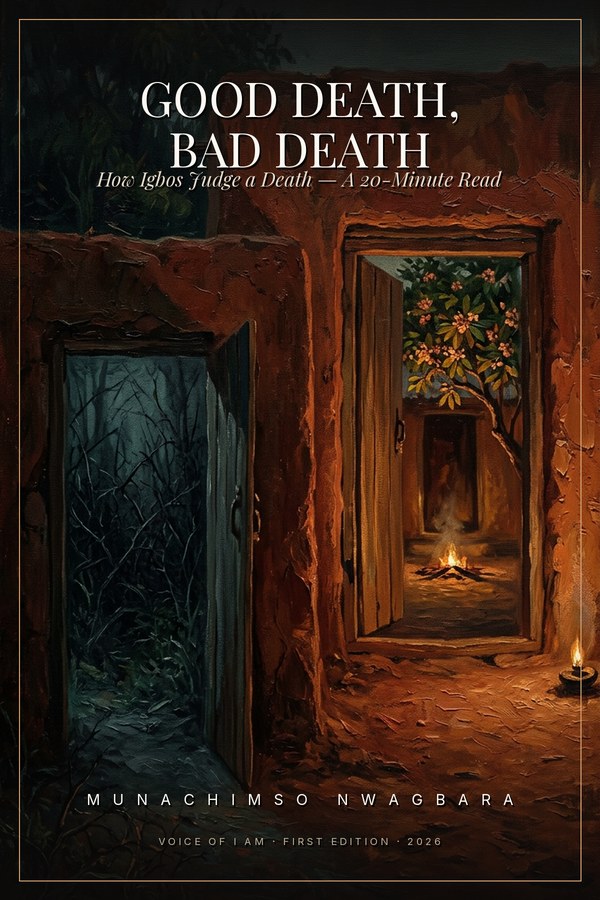
Ọnwụ ọma — the good death — is not the painless death and not the death you would choose. It is a death that meets certain criteria: old age, ripeness (completing the work you were sent to do), surrounded, in your own compound, with children, with last words spoken, with the body intact. The more criteria met, the better the death is considered. When a person dies a good death, the full ceremonial structure is available: first funeral, second funeral, transition to ancestor, ndichie.
Ọnwụ ojọọ — the bad death — is one where something is wrong. Young. Sudden. Alone. Away from home. Without children. Body not recovered. The community looks and says we have work to do. There is purification. The rites are different. The second funeral may be delayed or modified. The dead may not yet be able to join the ancestors.
5 chapters · Ten-question checklist · ~9,000 words · EPUB + PDF
The best time to ask is now, while everyone is calm.
Pay securely with Paystack · card, transfer, USSD · instant download
No. It will explain what the rites are, why they exist, what they cost, and what is flexible. Whether you do them — and in what form — is a decision between you, your elder, and your family. The guide is designed to make that conversation possible, not to make it for you.
Yes. It is written plainly enough that anyone can understand it, and it will give you the vocabulary to ask questions that would otherwise feel rude or intrusive.
No. Many Igbo families are Christian and still do the traditional rites; the guide acknowledges this and addresses how Christian families navigate the overlap. The author takes no position on which metaphysics to hold; he explains what the practices are.
Buy one copy per household, or buy one copy and share it with your siblings as part of preparing for the conversation. The printable checklist is designed to be printed and filled out together.
It is not too late, but the conversation is harder. Read the guide first, then choose a calm moment. If death is imminent, focus on questions 2, 3, 4, and 9 — body repatriation, preparation, provisions, and the will.
~9,000 words. About forty-five pages. You can read it in twenty minutes. The checklist is designed to be used over a visit home, not read once and put away.
Ask over Christmas. Ask over Easter. Ask on the next visit home. Do not wait for the phone to ring.
Get the guide — ₦11,000 →