Elias was four when he broke the radio. It was his father's — a large brown set that sat on the shelf like a piece of furniture, half sacred. His father repaired it, because that was what his father did. In the evenings it filled the sitting room with voices from Enugu and Lagos and London. Nobody else was allowed to touch it.
One afternoon he took a screwdriver from the kitchen drawer, copied the slow certain movements he had watched his father make, lifted off the back, and looked. Wires. Valves. The smell of dust and warm metal. A geography he could not read. He understood he did not know how to put it back. His mother walked in. The silence was worse than shouting. Only this child, she muttered on her way out, of all my children, only this one.
His father came home, sat with the wreckage for a long time, came to the boy's room, held out the working hand, and said: Show me where it came apart.
They rebuilt it together at the table. When the last wire was seated, his father turned the dial and the room filled with a voice. He looked at the boy with grave pleasure and said three sentences that would become the happiest memory of Elias's childhood, and also the seed of his whole error:
If you understand how a thing works, you can fix it. Take it apart carefully. See where each piece goes. Then it can be whole again.
At four he thought he was being taught how a radio worked. In truth he was being taught something he would spend the rest of his life misusing. That anything that troubles you can be opened up. Examined. Understood. And made to work again. He would spend his whole life trying to make the number stop mattering — the money, the fire, the thing his father could not say, the thing his wife could not forgive — and he would not understand until it was nearly too late that the number was never the thing he was afraid of.
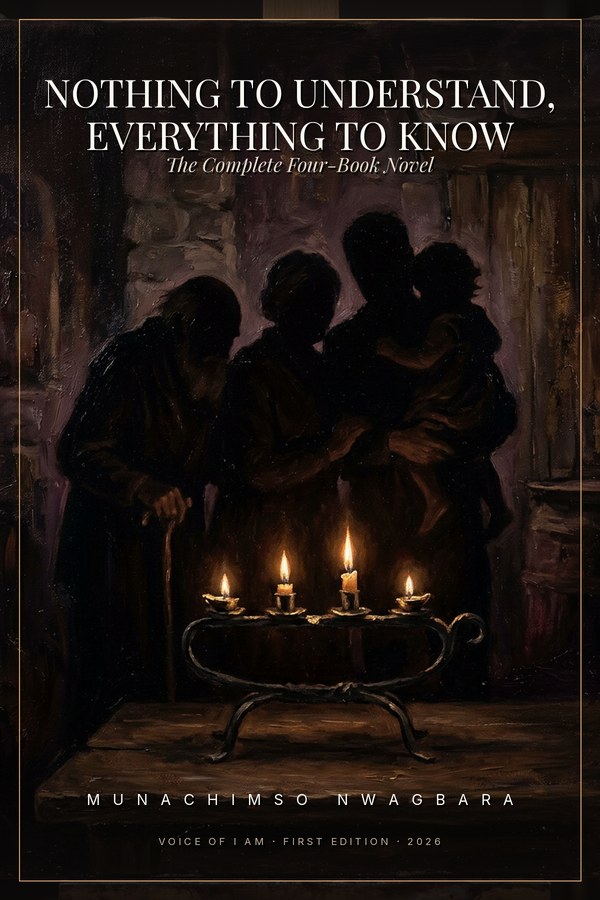
This is a novel about three people whose lives were braided together before any of them was old enough to know what a life was.
Four people died at Oduya in 2015. The city needed a villain. The city was given one. The city moved on.
But the truth is stored in five objects on a table fifteen years later: an engineering assessment correct in every particular signed by a man who knew there was a hole in the record and chose not to look into it; a photograph of the fire's aftermath holding a truth nobody saw, not even the photographer; a red cloth-bound notebook written in a code only one man could read; the testimony of a man who spent years in prison for a web of decisions that was not his; and the confession of a dying man about a brother-in-law he had destroyed, a son he had made hate a father, a death he could not undo.
Daniel had assembled it thinking he was proving a philosophy — that human beings cannot bear complexity, that we flatten a web into a chain, that the single-cause story is how we survive. He had been so busy proving it he had not noticed he was doing it himself. The web included him. It always does.
It is not just a newspaper habit. It is the operating system of most lives:
You spend years hating one person for a thing that a whole web of people touched, and the hatred keeps you from seeing your own place in it. You break things trying to fix them, because you believe the mechanism is the problem and the mechanism is never only the problem. You become a person who can see everyone clearly and cannot see the person holding the camera. You build a theology or a philosophy or a politics that explains everything and can explain nothing, because a world that needs a villain cannot be a world that includes you. You keep searching for understanding when what you needed was already across the dinner table — waiting, patient with you, while you looked past it for the answer.It is also not true crime. Oduya is not based on a specific fire in a specific year. It is built from the pattern of every fire in this country where a city needed a villain, and was given one, and then forgot.
A novel in four books · 91 chapters · ~97,000 words · EPUB + PDF
He thought he was being taught how a radio worked.
Pay securely with Paystack · card, Apple Pay, bank transfer · instant download
It is a Nigerian novel written by a man from Mgbowo who has read widely in both traditions and is writing in neither mode. Priests and pastors appear. The chi is named. The world the characters move in is the actual world most Nigerians live in, where Christian and traditional understandings sit beside each other without tidy resolution.
Oduya is not a single real event. It is built from the pattern of a dozen events the author has watched — in which a city needed a villain, was given one, printed the story, and moved on before the smoke cleared.
None of them. All of them. Elias has his father's hands. Mara has his watching. Daniel has his years of theological training and fracture. But these are fictional people, and any attempt to map them one-to-one onto real people will mislead.
There is an honest ending. The final chapter is not a triumph and not a funeral. It is a room with five objects and three people who now know what they did not know before. Whether knowledge is redemption is one of the questions the book asks rather than answers.
It is a book about a fire that kills four people and ruins a fifth's life, so parts of it are heavy. But it is also a book about a father and a son rebuilding a radio, about a grandmother seeing a child for the first time, about a man who learns to stop looking past the person across the dinner table. It holds both. It is honest, not cruel.
~97,000 words — about 490 pages. A proper novel. Not a novella. Read it at the pace novels want — a few chapters a sitting, with pauses. Do not rush. It rewards slow reading the way a careful photograph rewards slow looking.
No. This is fiction and self-contained. That said, readers of The Watching Mind, Trust It Twice, Choose It Twice, and The Alibi of the Mind will recognise the soil this novel grew in. The nonfiction books describe the patterns; this novel lets you live inside them.
Eventual print plans exist but there is no release date. Buy the digital edition now and the print-edition foreword and any revisions will arrive free as a lifetime update.
Five objects on a table. Three strangers. One afternoon. Everything to know.
Get the book — $19 →