Mbe the tortoise could not fly. He did not demand a ride. He asked for something far smaller: a single feather from each bird, that he might borrow their wings for a single day. The birds looked at each other and hesitated. They knew Mbe. In our language his name is also the word for one who takes what is not given.
Yet a feast without Mbe would be talked about for years. The sky was far. The feather was small. So each bird plucked one and gave it away. He soared. He ate as though the sky owed him a debt. On the way home, high above the earth, the birds pulled their feathers out one by one. The tortoise fell. His shell cracked into a hundred pieces. Every tortoise since carries the map of that fall on its back.
He loved the story as a boy. He identified with the tortoise — clever, sharp, never going to be the fool. He was forty before he realised the tortoise is not the subject. The birds are. They knew. They hesitated. They remembered his name. They handed over the feathers anyway, because a single feather felt cheap, the destination was distant, and the awkwardness of saying no on the ground felt heavier than the future cost of saying yes.
He has played the bird more times than he cares to admit. And once — just once — he was the feather. This book is what happened after the fall. Twenty-four laws for the inspection you run before takeoff, on yourself as much as on the person in front of you.
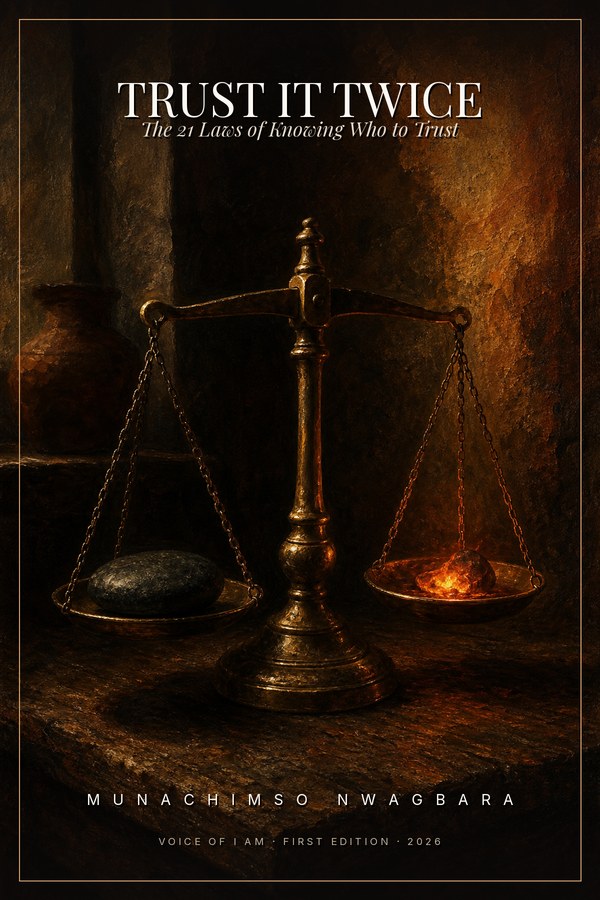
Most of what gets called "trusting someone" is not trust at all. It is a substitute — cheaper, faster, more flattering, more dangerous. The birds did not trust Mbe because they had inspected him. They trusted him because the moment was awkward and the feather was small and the feast was exciting.
The second half of the book (Part II) is devoted entirely to these substitutions — seven things that feel like trust and are not. Memorise them. They are the single most useful page in the book:
If every person who ever confused one of these things for the real thing had a naira for it, there would be no poor people in this country.
You think you lent something small. You discover, months or years later, what it actually bought:
Money you will never see again, guaranteed by a person who cried while making the promise. A partnership that drains five years of your life because the first alarm felt "too early to judge." A marriage where the thing that made you uneasy in month three is the thing that ends it in year seven. Reputational damage from vouching for someone whose pattern you could have seen if you had not confused charisma with character. The slow, private exhaustion of being the person who always gives the benefit of the doubt until the doubt is impossible to ignore.Every claim is graded for reliability in Appendix A. Historical examples (Fyre Festival, Holmes, Madoff, specific Nigerian cases the author has watched up close) are used because they are public records — not because they are dramatic. The patterns they demonstrate are the same patterns that break ordinary friendships on ordinary Tuesdays.
The core insight of the book is simple enough to write on an index card. Real trust survives five specific tests — and almost nothing that gets called "trust" survives all five:
Follow the incentive. What does this person get if you believe them? If the answer is large, slow down. Test the small before the large. Lend a small amount before you lend a life-altering one. Watch behaviour on a meaningless Tuesday before you watch behaviour on a wedding day. Let time do the arithmetic. Nothing that is true needs to be decided tonight. Almost every trap has a countdown. Read the record, not the story. What they did, over time, to other people — not what they are telling you they will do, to you, this time. Trust the dissenter. The person in the room who is not impressed, not charmed, not participating — that is the person whose vantage point you are missing.
24 laws · 3 interludes · ~55,000 words · EPUB + PDF
The awkwardness of saying no on the ground is always lighter than the cost of saying yes mid-air.
Pay securely with Paystack · card, transfer, USSD · instant download
No. Paranoia suspects everyone equally and is therefore useless. This book teaches you specific, repeatable tests. You will trust fewer people foolishly and the people you do trust you will trust more deeply, because the trust will be earned rather than lent by default.
No. It applies to business partners, mentors, pastors, friends, family, employers, employees, and the person who DMs you with an investment opportunity. The laws are the same in every room.
Just the opposite. The author writes with visible warmth about what real trust actually is — a thing built over time, through pattern, through small tests survived, through the dissenter being permitted to speak. Cynicism refuses to fly at all. This book teaches you to inspect the wings before you board.
Formally no. Practically, yes. If you cannot watch your own mind, you will not notice when your own urgency, your own need to be liked, or your own hunger for the feast is doing the deciding for you. The same part of you that falls for con artists is the part that wants to believe.
~55,000 words — about 280 pages. Two laws at a sitting. Let each one sit for a week before moving on. This is a book to practice, not finish.
No. It says charisma is not evidence of care. Some of the kindest, most trustworthy people you will ever meet are also charismatic. The point is to not let the glow of the performance substitute for the inspection of the pattern.
Then reading this book will be uncomfortable in a useful way. The laws work in both directions. If you find yourself recognising your own patterns in the "things that aren't trust" chapter, that is useful information. The book is not a weapon for judging other people. It is a mirror.
No. It will tell you that refusing to trust anyone is the other side of the same mistake — both positions avoid the actual work of inspection. The goal is not "more trust" or "less trust." It is better trust, lent at the right time, on the right terms, with eyes open.
You have known this since you were old enough to hesitate. This book gives you the language to act on it.
Get the book — ₦15,000 →